
Circles USA Values Defined
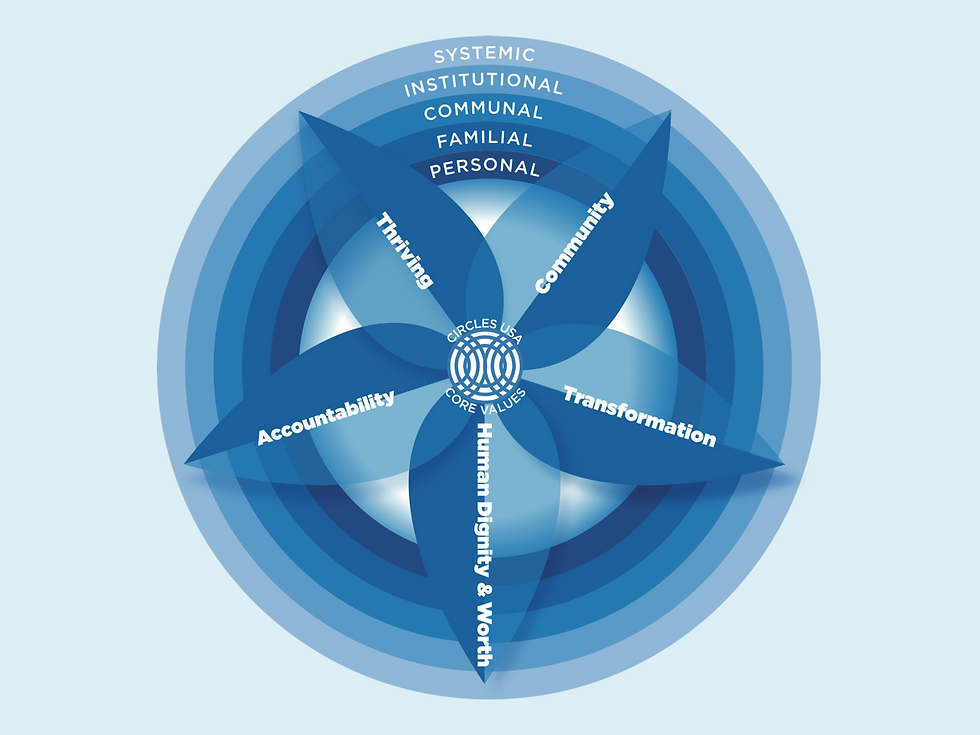
The Circles USA community of practice has identified five core values (Community, Transformation, Human Dignity & Worth, Accountability, and Thriving) as essential to realizing our Vision: All individuals live in equitable, thriving communities where poverty no longer exists. These values apply across every level of society—personal, familial, communal, institutional, and systemic—and form the foundation of our organization, our initiatives, and our daily work.
COMMUNITY
Community is the cornerstone of poverty alleviation.
We progress when we come together with intention, mutual care, and a shared commitment to one another’s well-being. In moments of hardship and seasons of growth, we are stronger, more resilient, and more powerful together. The meaningful connections formed in community build trust, strengthen social capital, and bridge differences. Community offers space to collaborate, communicate, and co-create, recognizing that each person is irreplaceable, each perspective adds value, and each contribution expands our collective capacity. Together, we cultivate belonging—a place to rest, play, work, imagine, and grow.
Community is both the container and the action. It reflects our interdependence, our responsibility to one another, and our desire to create spaces where everyone can thrive. It holds the emotional, practical, and relational labor required to uplift one another and invites us to choose empathy, collaboration, and shared growth over isolation or judgment. Community is our refuge and our launching point, an umbrella against the impacts of poverty and a foundation for purpose and possibility. When we choose to be in relationship across lines of difference, we become stronger together, restoring trust and weaving a network of support where every person can flourish.
Circles on Community:
Listen to Circle Leader Yakilin describe how asking for help from her Allies and community made all the difference.
Read how 2025 Leadership Conference keynote speaker Jomaris DeJesus and her organization The Prosperity Agenda use a Family-Centered Coaching framework to connect communities in need, fostering healthy interdependence.
CUSA Chief Learning Officer Kris Alexander discusses The Power of Community.
TRANSFORMATION
We are healing and evolving together.
Transformation is the movement of healing and evolving together. It is both deeply personal and profoundly communal, inviting us to unlearn what has harmed us so we can unlock what is possible. Transformation asks us to expand our beliefs about who we are and what we deserve, to embrace new perspectives, and to imagine different ways of being in the world. Through education, connection, and steady support, individuals and communities gain tools, claim their inherent power, and co-create new paths. As each person grows, the whole community grows with them, breaking old cycles and opening space for purpose, stability, and possibility.
Transformation is empowerment in motion. It reflects the deep shifts that occur when people experience safety, dignity, and agency, and when communities alongside one another toward healing and freedom. It honors the relational nature of change, recognizing that we rise through shared effort, shared learning, and shared courage. Transformation moves us toward wholeness—strengthening the collective, widening opportunity, and shaping a future where every person has the chance to flourish.
Circles on Transformation:
CUSA’s landmark Lives Transformed series highlights Circle Leaders who meet ordinary and extraordinary goals on their journeys out of poverty.
In this season 2 episode of our Big View podcast, “Transformational Relationships,” National Coach Addie Hartnett joins hosts Kamatara and Kris to explore how social bonds grounded in trust, reciprocity, and long-term commitment can radically shift the way we approach systems change.
HUMAN DIGNITY AND WORTH
Everyone is capable, creative, resourceful, and whole.
Human Dignity and Worth affirms that every person is inherently capable, creative, and whole. Every individual deserves to be honored, respected, and valued, regardless of race, ethnicity, ability, sexuality, gender, age, socio-economic status, or any other identity or lived experience. Worth is intrinsic; it is not earned through circumstance, productivity, or achievement. This recognition means all people deserve to exercise autonomy, pursue self-fulfillment, and thrive. Poverty is not a personal failing, and no one is broken or in need of fixing; each person brings unique contributions that enrich our communities and our collective work.
This value is both foundational and active. It calls us to treat everyone with honor, challenge unjust systems, and ensure equitable access, opportunity, and participation for all. By centering Human Dignity and Worth in our relationships and our work, we foster justice, equity, and respect, supporting individuals and communities in ways that empower, uplift, and strengthen the collective whole.
Circles on Human Dignity and Worth:
Executive Director Kamatara “Reimagines Labor on Labor Day,” arguing for a society in which “dignified labor starts with community… continues with policy…[a]nd requires all of us to speak up for an economy that serves people—not the other way around.”
Episodes 2.05 and 2.06 of The Big View podcast feature Meenadchi (a somatic healing practitioner and author of Decolonizing Non-Violent Communication) breaking down the core components of Empathic Intelligence and discussing its importance in navigating trauma, poverty, systems change, and conflict.
ACCOUNTABILITY
Taking intentional action with integrity and responsibility.
Accountability is the commitment to act with integrity, responsibility, and intentionality—both individually and collectively—to create equitable opportunities for all. It centers justice, fairness, and equity, ensuring that individuals and communities most affected by poverty have the power, voice, and resources to influence and shape the systems that impact their lives. Personal accountability asks each of us to act ethically, honor commitments, and reflect on the impact of our choices, while communal accountability focuses on shared responsibility, collective stewardship, and inclusive decision-making. Together, these forms of accountability strengthen trust, remove barriers, and support meaningful participation so that everyone has a fair chance to thrive.
This value is both principle and practice. It calls for courageous advocacy, ethical stewardship of resources, and the intentional redistribution of power to address systemic inequities and root causes of oppression. Accountability encourages reflection, responsibility, and alignment between values and actions, fostering growth on individual and community levels. By embracing accountability in all aspects of life, we build communities and systems where people are empowered, supported, and able to contribute meaningfully, creating long-term, sustainable change that benefits both individuals and society as a whole.
Circles on Accountability:
2025 conference keynote speaker Chantel Chapman (author of The Trauma of Money and CEO and Founder of The Trauma of Money Institute) takes a nuanced view of accountability, encouraging us to take “financial healing” steps within our power while releasing shame around predatory economic systems.
Circles USA reports chapter results at individual and community levels. Our data—available to the public via Impact Reports and Case Studies—looks in-depth at personal and collective accountability models as participants grow skills and income, decrease dependence on public assistance, and expand resources and support networks.
THRIVING
We all deserve the opportunity to live a full, abundant, and purposeful life.
Thriving is the opportunity to live a full, abundant, and purposeful life. It goes beyond meeting basic needs, encompassing economic stability, upward mobility, and access to the resources, opportunities, and support necessary to achieve personal goals and dreams. To thrive is to experience self-fulfillment, social connection, and a sense of agency, while being equipped to navigate life’s chapters with confidence. Thriving recognizes that success looks different for each individual and family, honoring the choices, aspirations, and values that guide their journey while providing the tools and platforms to create lasting impact.
Thriving is both personal and collective. It is about lifting one another up, building generational wealth, creating opportunities for education, exposure, and growth, and contributing to sustainable, long-term change in our communities. It encompasses measurable outcomes as well as the deeper experience of dignity, possibility, and participation in life. By fostering thriving, we cultivate an environment where individuals, families, and communities can flourish together—reaching their potential, achieving their dreams, and leaving poverty behind while building a future of equity, abundance, and shared prosperity.
Circles on Thriving:
CUSA’s Leadership Development Spotlight series honors graduated Circle Leaders (like Susan D. Richards of Circles Ashland and Cody Martensen of Circles Utah Valley) who have stepped into challenging service roles at the chapter, regional, and even national levels—exemplifying what it means to move from surviving to thriving.
This Cliff Effect panel from our 2025 conference brought together national economic researchers, state policy advocates, and locally-rooted practitioners to share what’s working, what’s emerging, and where we must focus next to advance thriving communities wherever we live.
“Social capital is the safety net,” CLO Kris Alexander writes in her blog post, The Healing Power of Social Capital. “It’s the community we create around one another and the key to removing the systemic barriers keeping people in poverty. It’s what turns surviving into thriving, isolation into belonging, and hardship into hope.”
Building Community to End Poverty in 25 States


